Case file BK022Meme moments · July–August 2020
Binod: that was the entire comment.
In 2020, Slayy Point highlighted a YouTube comment containing only a name. People began repeating Binod elsewhere, leaving newcomers with one very reasonable question.

Inside this case
You could open a comments section in the summer of 2020 and find a contribution that didn’t seem to concern the video at all. Binod. Then another person would post it, which was not much help if you were trying to work out who Binod was.
The explanation was available. It just didn’t make the comments much more informative. People were repeating a name because a video had drawn attention to someone posting the name. Knowing that could leave you almost as puzzled about the appeal as before.
It could also leave you tempted to type it yourself.
A video about comments gave people another comment to make
The Indian Express’s contemporary account (opens in a new tab) traces the wave to Slayy Point’s 15 July 2020 video about Indian comment sections. Creators Abhyudaya Mohan and Gautami Kawale highlighted a comment from an account called Binod Tharu. The comment was simply “Binod”.
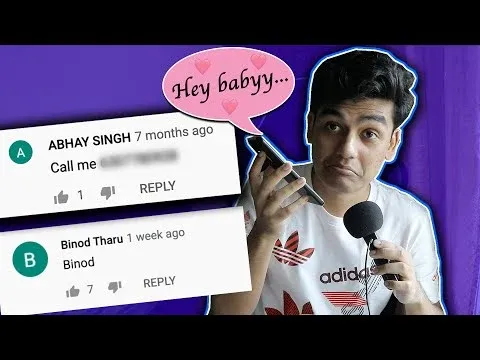
There was the whole contribution: “Binod”. Slayy Point’s own thumbnail for the July 2020 comments video puts the name beside the baffled reaction.
Source: Slayy Point / YouTube (opens in a new tab). Editorial excerpt. Converted to WebP for display; original framing retained.
That small discovery gave the audience something exceptionally easy to copy. You didn’t have to reproduce a performance or make a new picture. The whole contribution was already there, with no difficult spelling to practise.
By August, the name had spread into other comments and Twitter jokes. Slayy Point’s own follow-up video (opens in a new tab) became part of the record too. A comment noticed for being unhelpfully brief had acquired enough attention to need more explaining.
The account name is part of that public trail. There is no need to invent a private life or a theory about the original commenter’s intentions to make the joke work.
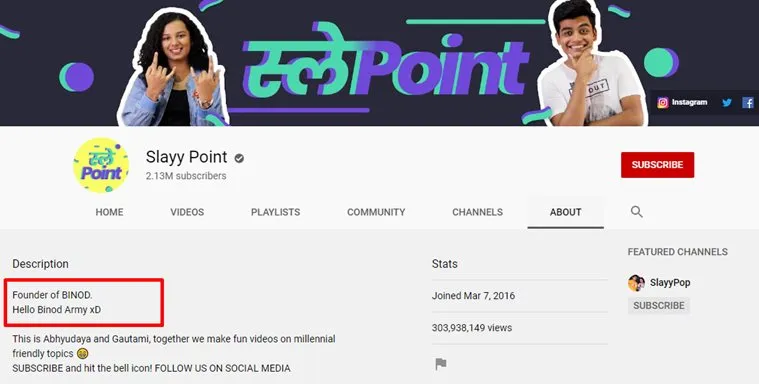
The channel’s response found its way into the About page too. This screenshot preserved in the August 2020 coverage shows how quickly the stray comment became part of Slayy Point’s identity.
Source: Slayy Point, via The Indian Express (opens in a new tab). Editorial excerpt. Converted to WebP for display; original framing retained.
You either recognised it or had to ask
Under an unrelated post, the word could make more sense to someone who knew the reference than to a reader following the actual subject. Without that background, it looked like a conversation had started somewhere else and arrived without the introductory message.
That gave the repetition a small social reward. You could take part with almost no effort and expect someone to understand why you had done it. The subject of the post wasn’t necessarily involved.
Being baffled also gave other people a reason to explain the story, sometimes at much greater length than its practical requirements justified. After all that background, participating still only required the one word.
The original Slayy Point video had been looking at the things people leave beneath videos. Its audience supplied a fresh example at a scale the original comment didn’t suggest.
The short version really was short
There wasn’t a fixed hidden definition waiting at the end of the explanation. The name was recognisable because people kept using it in places where its ordinary meaning didn’t explain its presence.
That is why reading about Binod now can be slightly unsatisfying if you expect a final piece of information to make everything click. You can know where the joke came from and still think the comments look much the same.
Someone who was there might laugh at the reminder. Someone meeting it for the first time might look back at the name, pause, and ask whether that is really all there was to it. Fair question.
The craze timeline
The rise. The afterlife.
A Bukhaar reading, from first spark to afterglow.
- WarmSlayy Point highlights the one-word Binod comment in its video about comment sections. (opens in a new tab)
- Fever pitchThe name spreads across comments and Twitter jokes in contemporary Indian coverage. (opens in a new tab)
- CoolThe July–August 2020 comment wave is the reference preserved here, with no fixed final day assigned to the joke.
A little temperature check
The bukhaar meter.
At its peak · Aug 2020
Fever pitch
The name spreads across comments and Twitter jokes in contemporary Indian coverage.
Now · Nov 2026
Cool
The July–August 2020 comment wave is the reference preserved here, with no fixed final day assigned to the joke.
Peak: Fever pitch · Now: Cool
Bukhaar’s editorial take · Nov 2026