Case file BK011Collectibles · Late 1990s–2000s
Tazos: the chips were just the packaging.
A Parker pen traded for a snack-packet disc: Tazos inspired some serious negotiations in 1999. The missing designs could matter much more than the chips.

Inside this case
Tushar traded a Parker pen for a Tazo. It is a small detail from Outlook’s 1999 report (opens in a new tab) that explains the craze rather better than calling the discs free gifts.
Somebody had paid for that pen. Somebody else had bought the chips. Between them, the children had decided what they really wanted, and the stationery had lost.
The same report described ten-year-old Ishan using time spent outside class as a chance to exchange discs. Being sent out for talking had turned out to have an unexpected advantage. There were collections to improve.
Buying a snack became a complicated decision
The promotional campaign put collectible discs in Lay’s and Cheetos packets. A September 1999 Delhi High Court judgment (opens in a new tab) reproduces Frito-Lay’s account that the Indian campaign began around September 1998. That is the company’s stated history in the record, rather than a date recovered from someone’s childhood memory.
Some discs had grooves for connecting them, and the judgment described games played with them. You could do more than look at the picture. There was a reason to keep a disc after the packet was empty.
Outlook’s contemporary reporting supplies the negotiations that followed. It described children swapping Tazos, parents fielding demands for more packets and schools treating them as a classroom problem. Series included Looney Tunes and Space Jam. Buying one packet could leave you with a new design and several reasons to want another.
For an adult looking at the purchase, the snack might seem the obvious point of the transaction. A collector would have wanted to inspect the other contents first.
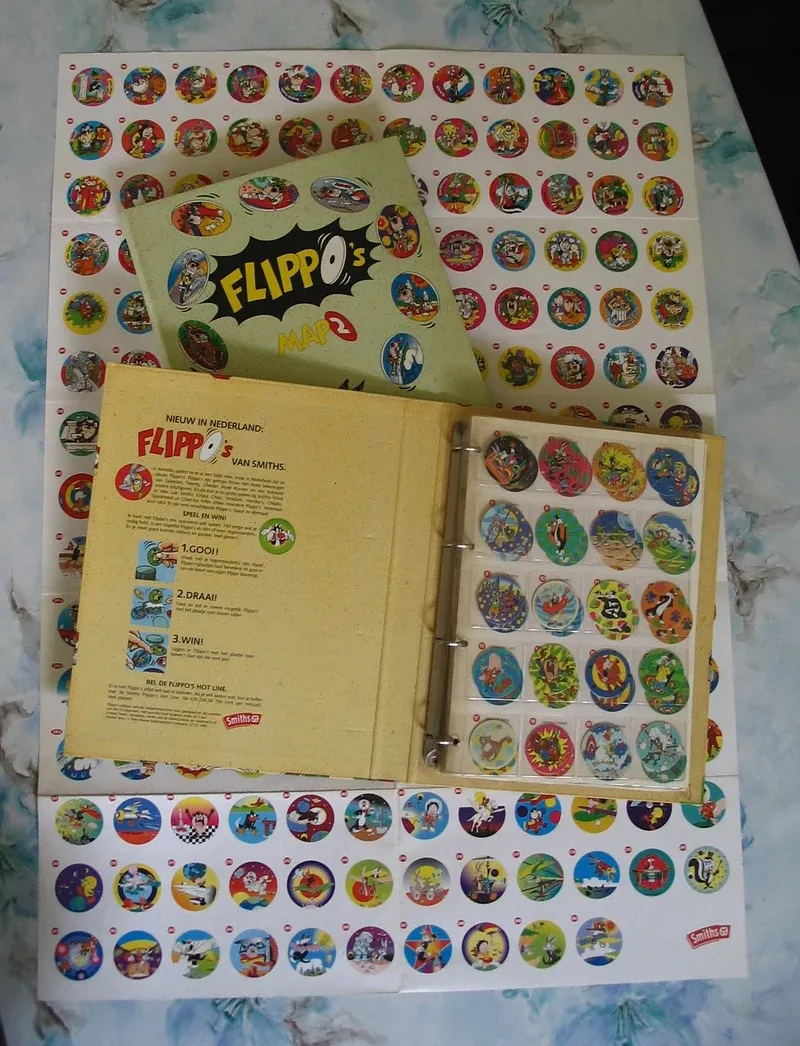
A collection large enough to need albums. Bruce van der Kooij photographed these Dutch-market Flippos in August 2005; the familiar character discs are an overseas collecting example, rather than evidence of India’s 1998 launch.
Photo: Bruce van der Kooij (Brucevdk) (opens in a new tab) · CC BY-SA 3.0 (photograph) (opens in a new tab). Editorial excerpt (character artwork). Converted to WebP for display; original framing retained.
You already had that one
Finding a design you already owned could take some of the pleasure out of opening the packet. The chips hadn’t changed, but you might have been hoping for something else from this purchase.
A duplicate could recover its value as soon as you found the right person. Someone else might be missing precisely that disc. Now you had to decide what they owned that you wanted, and whether either of you was prepared to give it up. A small collection could require a surprising amount of discussion.
The missing pieces made it difficult to feel finished. You might have plenty of discs and still be thinking about the one you hadn’t found. Another packet offered the possibility of sorting that out, along with the possibility of another duplicate.
The pen exchange in Outlook’s report is funny partly because it makes the stakes visible to an adult. To the children involved, a desirable Tazo already had enough value to justify a deal. The brand didn’t have to provide an exchange rate.
Some of the discs stayed
A collector’s 2024 photo post (opens in a new tab) records a surviving collection. It is evidence of somebody keeping these particular objects, rather than a measure of how many people still collect them.
Seeing the designs again can be more effective than a general invitation to remember the nineties. You can recognise the disc before you have recalled the packet it came from. If you collected them, you might even remember which one had been difficult to get.
There is no need for an impressive resale price to explain why someone would keep them. A box of Tazos can contain a design you liked, a bargain you were pleased with and several duplicates you never quite managed to exchange. The chips, at least, were easier to finish.
The craze timeline
The rise. The afterlife.
A Bukhaar reading, from first spark to afterglow.
- WarmThe Indian campaign begins, in the company’s account. (opens in a new tab)
- Fever pitchCollectors, swaps and parental negotiations make the news. (opens in a new tab)
- WarmA collector shares discs that survived the packets. (opens in a new tab)
- WarmFrom packet prize to keepsake. A saved collection still has more personality than its wrapper.
A little temperature check
The bukhaar meter.
At its peak · 1999
Fever pitch
Collectors, swaps and parental negotiations make the news.
Now · Nov 2026
Warm
From packet prize to keepsake. A saved collection still has more personality than its wrapper.
Peak: Fever pitch · Now: Warm
Bukhaar’s editorial take · Nov 2026
Sources & further reading
- Contemporary 1999 reporting on collectors, swaps and snack marketing (opens in a new tab)Outlook
- A dated documentary account of the Indian promotional campaign (opens in a new tab)Delhi High Court judgment, reproduced by SooperKanoon
- An individual collector’s surviving collection, not a population estimate (opens in a new tab)r/IndiaNostalgia