Case file BK012Collectibles · 2000s, especially 2005 onward
Beyblade: choosing a top was serious business.
Beyblade reached Indian television and toy shelves in 2005. A spinning top now came with a launcher, a rival and a cartoon’s worth of reasons to care.
Inside this case
The top would stop spinning eventually. Whether that settled the argument was another question.
Beyblade offered a simple contest with plenty of room to care about the equipment. You launched a top against someone else’s and watched what happened. If you also watched the cartoon, a collision between small toys could come with a much bigger story attached.
An ordinary spinning top was enjoyable enough. This one gave you an opponent, something to practise and a reason to think your choice of top might matter enormously.
The cartoon was already explaining the appeal
An August 2005 Exchange4media report (opens in a new tab) said Cartoon Network Enterprises had secured Indian licensing rights for Beyblade toys. It also dated the show’s Cartoon Network premiere to May that year.
The licensing report was enthusiastic about the business opportunity. Its useful historical detail is the connection: Indian viewers could see a series built around top battles and encounter merchandise associated with it. The show and the product were arriving as parts of the same invitation.
You didn’t have to invent a game around an unexplained object. Television had already shown why characters cared about competing, what a dramatic contest looked like and how seriously a person might take winning one.
The real toys were unlikely to reproduce the animated effects. That didn’t prevent a player from bringing some of the enthusiasm to the launch.
Something to try after the episode
Indian Television’s November 2005 report (opens in a new tab) covered a Funskool Beyblade range and linked it to the Cartoon Network programme. That helps place the Indian television-and-toy moment without relying on somebody remembering the year they first owned one.
A toy designed to meet another toy also gave you a reason to find another player. You needed somewhere suitable to compete and some agreement about how the contest would work. Then there was the question of which top to use.
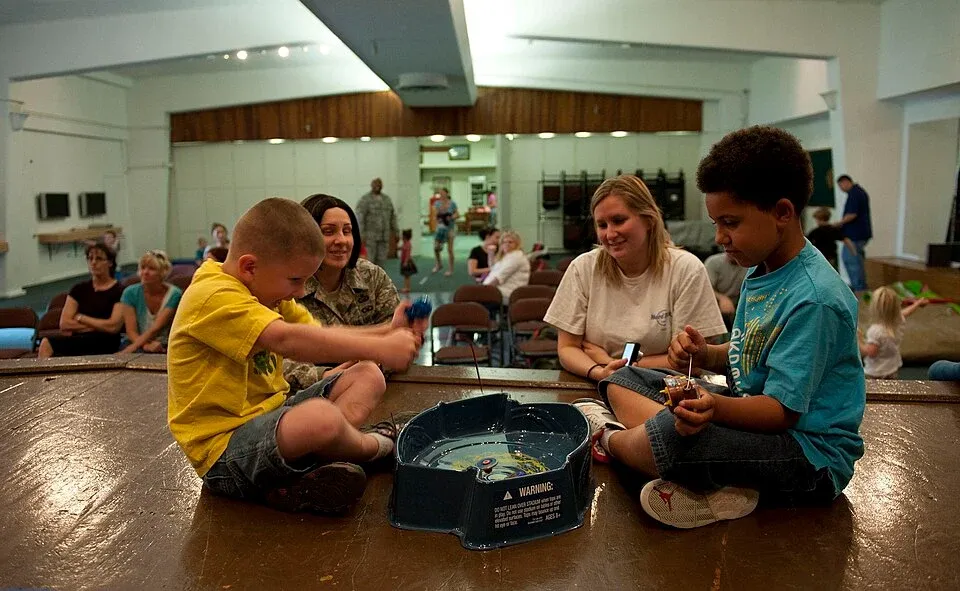
Launchers ready, adults watching. A Beyblade tournament at Incirlik Air Base, Turkey, on 18 April 2012 shows the contest beyond the cartoon, several years after the Indian launch discussed here.
Photo: Senior Airman Clayton Lenhardt / U.S. Air Force (opens in a new tab) · Public domain (opens in a new tab). Resized and converted to WebP; no crop or content changes.
Losing a round after talking up your top would put you in a mildly awkward position. The equipment might have been oversold. A rematch could help demonstrate that it had simply been a poor launch.
That is an easy route to another round. A visible result doesn’t necessarily exhaust the explanations available to the participants. With practice involved, you can reasonably hope the next attempt will go differently.
Individual fans remember different makes, improvised playing spaces and local rules. Those memories shouldn’t be combined into a single account of how every Indian child played. The documented link between the show and the merchandise is clear enough to explain the appeal on its own.
A top doesn’t have to belong to its first craze
The 2005 reports capture an Indian wave within a longer franchise. They don’t provide a final day of play or prove that a later generation encountered exactly the same products.
What is easy to recognise is the pleasure of trying a contest yourself after watching a much more elaborate one on television. A launcher could turn a small object into something worth preparing for.
The top might wobble sooner than you expected. You could always ask for another round before drawing conclusions about its capabilities.
The craze timeline
The rise. The afterlife.
A Bukhaar reading, from first spark to afterglow.
- WarmBeyblade premieres on Cartoon Network in India, according to the licensing report. (opens in a new tab)
- HotCartoon Network Enterprises announces Indian toy licensing rights. (opens in a new tab)
- Fever pitchFunskool’s Micro Tops Battling Game adds to the television-linked toy range. (opens in a new tab)
- WarmThe 2005 television-and-toy wave is the chapter recorded here. The sources do not establish a final day of play.
A little temperature check
The bukhaar meter.
At its peak · Nov 2005
Fever pitch
Funskool’s Micro Tops Battling Game adds to the television-linked toy range.
Now · Nov 2026
Warm
The 2005 television-and-toy wave is the chapter recorded here. The sources do not establish a final day of play.
Peak: Fever pitch · Now: Warm
Bukhaar’s editorial take · Nov 2026