Case file BK004Apps · July 2019
FaceApp: suddenly, looking older was the idea.
In July 2019, FaceApp made older selfies worth sharing. Indian celebrity posts helped the joke along, while questions about uploaded photographs followed close behind.

Inside this case
You could look at an aged FaceApp selfie and begin checking for family resemblance. Was that your father’s face? An aunt’s expression? The app had added wrinkles and grey hair, but left enough of the original person for a comparison to feel worth making.
In July 2019, looking older was the point. You selected a photograph, applied the effect and had a possible future face ready to show somebody. Whether it looked flattering was hardly the first question. Did it look convincing?
For a photo effect, that was a useful way to get people to examine the result rather closely.
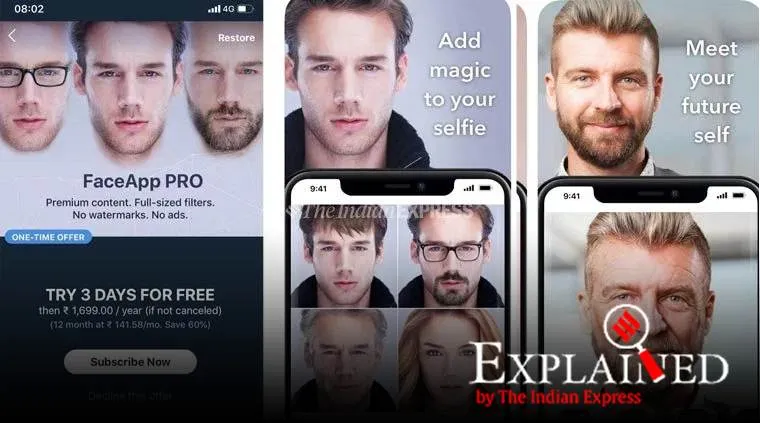
The appeal was visible before the small print: FaceApp’s younger and older faces, as reproduced in the July 2019 explainer.
Source: FaceApp / The Indian Express (opens in a new tab). Editorial excerpt. Converted to WebP for display; original framing retained.
Familiar faces, several years later
FaceApp had been around since 2017. TIME’s July 2019 coverage (opens in a new tab) described the existing app’s renewed popularity through the age-filter challenge. This was a new burst of attention for a tool that already existed.
Indian celebrities provided recognisable examples. The Indian Express’s gallery (opens in a new tab) documented Varun Dhawan and Arjun Kapoor sharing their transformed photographs, alongside other performers who had tried the filter. You could compare a familiar actor’s present face with the app’s version without needing the effect explained.
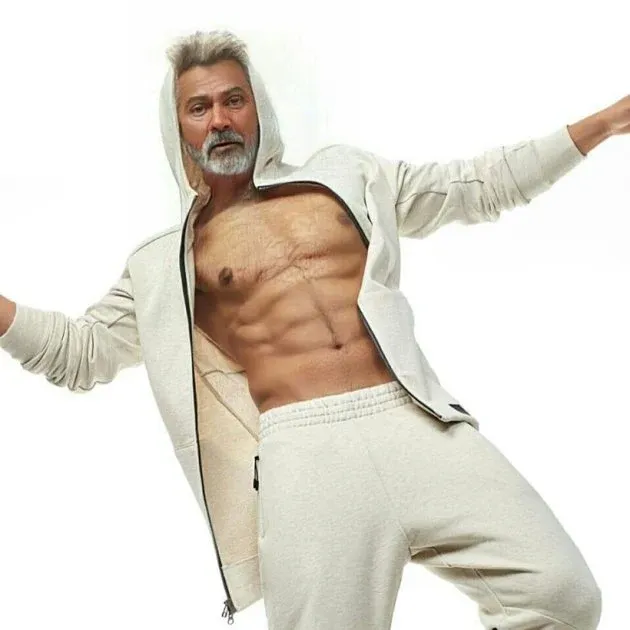
Varun Dhawan’s grey-haired version of himself from the July 2019 gallery. It was an edited portrait, with no need to wait for the calendar.
Source: Varun Dhawan / FaceApp, via The Indian Express (opens in a new tab). Editorial excerpt. Converted to WebP for display; original framing retained.
Trying it on yourself added another kind of curiosity. Imagine showing the result to someone who knows your family. They might see a resemblance you hadn’t noticed, or disagree completely with the future hairstyle. A filter could give you a picture to pass around and a fairly easy conversation to start.
It was still an edited image, rather than a reliable prediction of how a person would age. The resemblance could be entertaining without becoming a forecast.
What happened to the photograph you uploaded?
The effect required a photograph to work on. As the aged faces circulated, attention also turned to the terms governing those uploads and the fact that editing involved the cloud.
The Indian Express’s contemporary explainer (opens in a new tab) reported FaceApp’s statement that most uploaded images were deleted from its servers within 48 hours. It also examined the permissions in the terms. The deletion statement was the company’s 2019 assurance, not an independent audit or a promise about every later version of the service.
A before-and-after image was much easier to understand than that discussion. You could see the changes to a face immediately. Working out what access you had granted, what happened on a server and how much trust to place in a statement took more effort.
The attraction had been so simple that those questions could feel like an unwelcome complication. They were still questions about the same photograph. Enjoying what came back didn’t settle what had happened to the original.
The filter made an oddly specific keepsake
FaceApp still offers a photo editor (opens in a new tab). The old-age selfies belong to a particular 2019 wave, rather than marking the whole life of the app.
If one of those images survives in a chat, it can look slightly strange now for a reason the original joke didn’t need to consider: some actual time has passed. You can compare yourself with a version of the future that a filter produced years earlier.
The app couldn’t tell you who you would become. It could give your friends a photograph to look at and somebody in the family an opportunity to point out that you had always looked like that relative.
The craze timeline
The rise. The afterlife.
A Bukhaar reading, from first spark to afterglow.
- WarmFaceApp arrives, before the big ageing revival. (opens in a new tab)
- Fever pitchOlder selfies, celebrity posts and privacy questions share the spotlight. (opens in a new tab)
- WarmThe editor is still available. The 2019 ageing party trick has its own place in the family album.
A little temperature check
The bukhaar meter.
At its peak · Jul 2019
Fever pitch
Older selfies, celebrity posts and privacy questions share the spotlight.
Now · Nov 2026
Warm
The editor is still available. The 2019 ageing party trick has its own place in the family album.
Peak: Fever pitch · Now: Warm
Bukhaar’s editorial take · Nov 2026
Sources & further reading
- The 2019 filter and contemporary privacy questions (opens in a new tab)The Indian Express
- Contemporary coverage of the app’s revival and celebrity sharing (opens in a new tab)TIME
- Indian celebrity posts during the July 2019 wave (opens in a new tab)The Indian Express
- FaceApp’s current photo editor (opens in a new tab)FaceApp