Case file BK006Apps · 2000s–2014
Orkut: would you write me a testimonial?
Scraps, communities and a friend writing nice things about you: Orkut offered a very particular way to be social online before its 2014 goodbye.
Inside this case
Asking a friend to write nice things about you is a slightly awkward social arrangement. Orkut gave it a feature name. A testimonial could sit on your profile, explaining to visitors what a delightful person you were, in somebody else’s words.
If you had ever struggled to describe yourself, this had its advantages. The difficult part might come later, when the friend who had praised you so generously wanted one in return.
Alongside scraps and communities, testimonials belong to a vocabulary that can bring back a particular period of being online before you have remembered your old profile photograph.
Your profile came with other people’s contributions
The Indian Express’s retrospective (opens in a new tab) describes Orkut’s scraps and testimonials, and communities formed around interests including Bollywood and cricket. There were different ways to make yourself visible: what you wrote, what friends wrote about you and the groups you chose to join.
A testimonial made affection unusually public. A friend could take considerable trouble over an appreciative paragraph while wanting it to look as though the words had come easily. The person being described would know whether it sounded sincere. So, potentially, would several mutual friends.
A community did something different. Its subject gave strangers a starting point for conversation. You could seek out people interested in something you liked, rather than needing to know them before you arrived. Joining also added another small detail to the version of yourself a visitor could see.
None of that means the old web was always kind. It does explain why the memory of Orkut can attach to a particular feature rather than a general sense that social media used to be better. A scrap or a testimonial involved a specific thing somebody had taken the trouble to write.
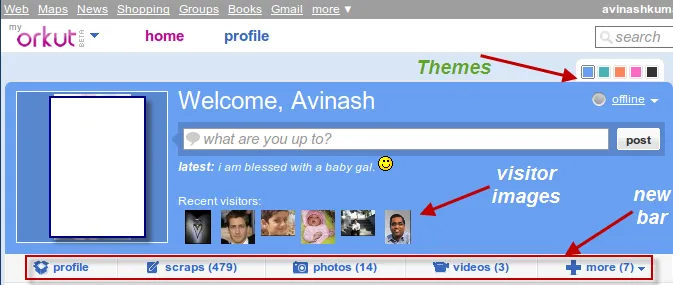
Scraps, photos, visitors and colours to fiddle with. Avinashtech’s November 2009 screenshot records the redesign while it was new; the arrows are the original blogger’s annotations.
Source: Avinash / Avinashtech · Orkut by Google (opens in a new tab). Editorial excerpt. Converted to WebP for display; original framing retained.
Google put a date on the goodbye
In its June 2014 farewell (opens in a new tab), Google announced that Orkut would close on 30 September. It said growth at other services, including YouTube and Blogger, had outpaced Orkut, and gave users time to export their material.
That was a fairly definite ending for the original service. It didn’t depend on whether a particular friend group had already moved elsewhere or still checked in. There was a date after which the old routine would no longer be available.
The announcement also proposed an archive of public communities. That was the plan Google described then, rather than a promise that every old profile, exchange or photograph can still be recovered now.
A familiar name doesn’t bring the scrapbook back
Later discussion about Orkut’s founder or a possible return can be interesting without amounting to the restoration of the original network. The old relationships and their written traces were part of what people used, not just the name above the page.
Consider the testimonial again. A new site could provide the same box for appreciative words. It couldn’t reproduce the moment when a particular friend sat down to explain, rather enthusiastically, what you were like.
Somebody may have oversold your sense of humour. You may have approved the testimonial anyway. That is a more recognisable thing to miss than an abstract version of a simpler internet.
The craze timeline
The rise. The afterlife.
A Bukhaar reading, from first spark to afterglow.
- WarmGoogle starts its first social network, Orkut. (opens in a new tab)
- Fever pitchA redesigned Orkut adds support for several Indian languages. (opens in a new tab)
- WarmGoogle announces the farewell and gives users time to export their material. (opens in a new tab)
- CoolThe original service reaches its announced shutdown date. (opens in a new tab)
- CoolThe original network closed in September 2014. Its scraps and testimonials belong to that service.
A little temperature check
The bukhaar meter.
At its peak · 2007
Fever pitch
A redesigned Orkut adds support for several Indian languages.
Now · Nov 2026
Cool
The original network closed in September 2014. Its scraps and testimonials belong to that service.
Peak: Fever pitch · Now: Cool
Bukhaar’s editorial take · Nov 2026